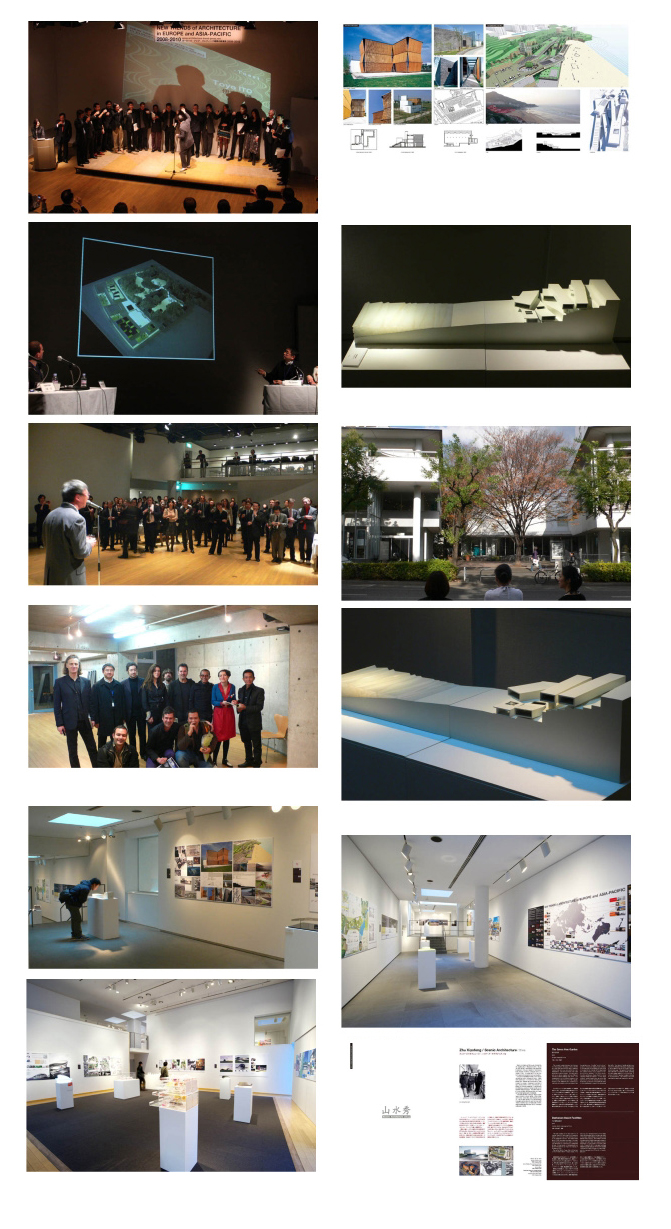
The fifth and final series of“New Trends of Architecture in Europe and Asia-Pacific” was launched in Tokyo, Chinese architect Xiaofeng Zhu was selected as one of the 15 participating architects from 15 countries/regions
On the 5th December, 2009, the fifth and final series of “New Trends of Architecture in Europe and Asia-Pacific” was launched at Hillside Terrace, Tokyo, with the attendance of 150 guests. The opening reception marked the beginning of the final phase of a decade-long project that has been organized since 2001.
Mr. Hakuo Yanagisawa, parliamentarian and the Chairman of the Japan Committee, and Mr. Hugh Richardson, Ambassador of European Union to Japan, made an opening remark and appreciated the efforts of the organisers, the Commissioners, the host cities, and the participating architects. The commissioners, Sir Peter Cook and Mr. Toyo Ito, as well as all 15 groups of architects came together to the Tokyo opening.
It was the first time in the New Trends history that all the participants assembled.
Commissioners: Prof. Sir Peter Cook (Europe) Toyo Ito (Asia-Pacific)
Honorary Advisors: Alvaro Siza Fumihiko Maki 15 Participating Architects
France: Isabel Herault and Yves Arnod
UK: C.J Lim/ Studio 8
Spain: Izaskun Chinchilla
Portugal: Bernardo Rodrigues
Norway: Helen and Hard
Hungary: Adam Somlai-Fischer/ Aether Architecture
Austria: Wolfgang Tschapeller
Turkey: Han Tumertekin
Japan: So Fujimoto
China: Zhu Xiaofeng/ Scenic Architecture
Korea: Moongyu Choi
Taiwan: Yu-Tung Liu
Singapole: Yap Mong Lin
Australia: Simon Pendal
Thailand: Suriya Unparisiriratana
On the next day, a symposium was held all day long. Sir Peter Cook made a key-note lecture on “new trends” in architecture and his update projects. He pointed out the international network of elitism in architectural education. Now that architects study and work beyond borders, there are rather common points than differences among them, while they show some localities and specialties.
Sir Peter’s presentation with a dramatic gesture conveyed his incessant curiosity and love for architecture to the audience. The participating architects were grouped into four sessions, which were moderated respectively by the Japanese architects who participated in the previous editions: Kazuhiro Kojima, Yoshiharu Tsukamoto (Atelier Bow Wow), Masashi Sogabe (Mikan) and Nobuaki Furuya. For each session, the architects including the moderator made a 10-minute presentation on their own work, which were followed by lively discussions. The styles of their presentations showed a great variety and represented their approach to architecture in a sense. After four sessions, Prof. Hiroshi Hara, who acted as the Commissioner of the 3rd edition, made a special presentation on the projects which had not been realized in his nearly half a century career.
The accumulation of his unrealized projects was overwhelming, and taught us that the architect always dreams architecture in the real.As the Commissioner, Mr. Ito concluded the symposium with comments on the presentations and discussions that were made all that day. He was impressed that architecture has been more liberated and freer. Many architects want to create architecture, but at the same time want to destroy its stereotypes.
He emphasized that architecture should be fun, make the real more interesting and encourage people. In the end, he projected a tree on the screen to be compared to contemporary architecture which requires generative, unstable, diverse, relative, complicated and dynamic orders. In addition to the symposium, the overseas architects were invited to universities to give individual lectures. After the Tokyo program, Sir Peter participated in the symposium at Kumamoto Artpolis for which Mr. Toyo Ito works as the Commissioner.
The exhibition is scheduled to travel to Niigata City, Lisbon, Barcelona and Istanbul. Other under-consideration cities include Linz, Shanghai, Hong Kong, Tai Pei and Perth. We hope that fruitful discussions and exchanges will be continued and developed until 2010.